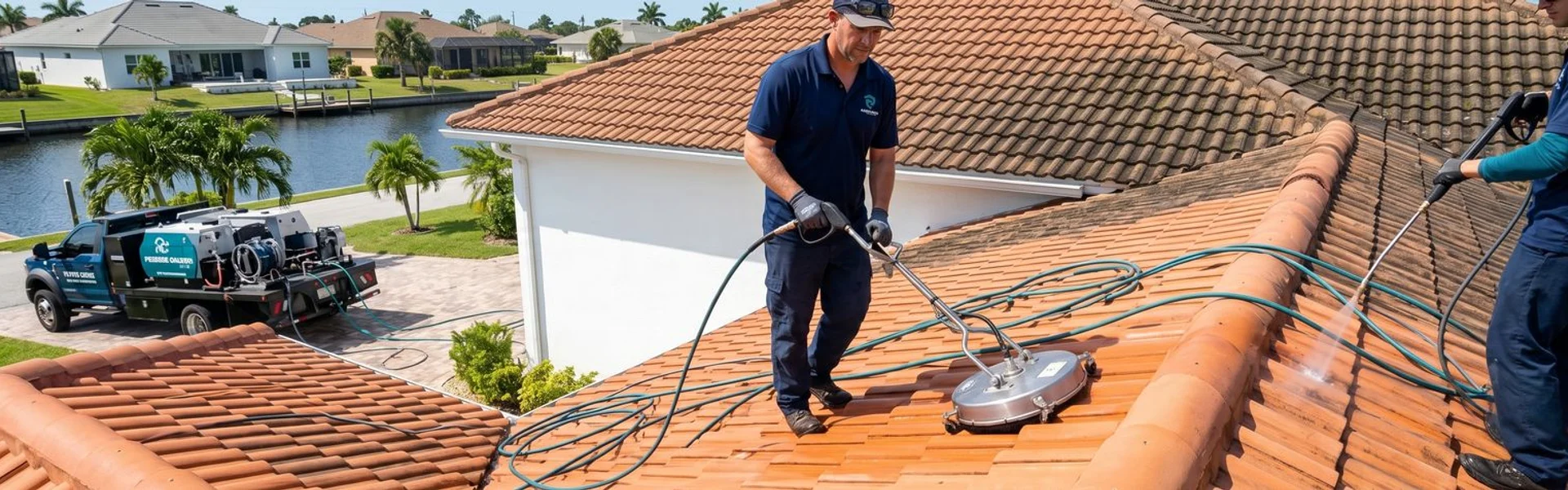
What Soft Wash Roof Cleaning Is (and Why It Beats Pressure)
Soft wash roof cleaning uses chemistry (not pressure) to kill algae at the root. Safe for shingle, tile, and metal roofs.
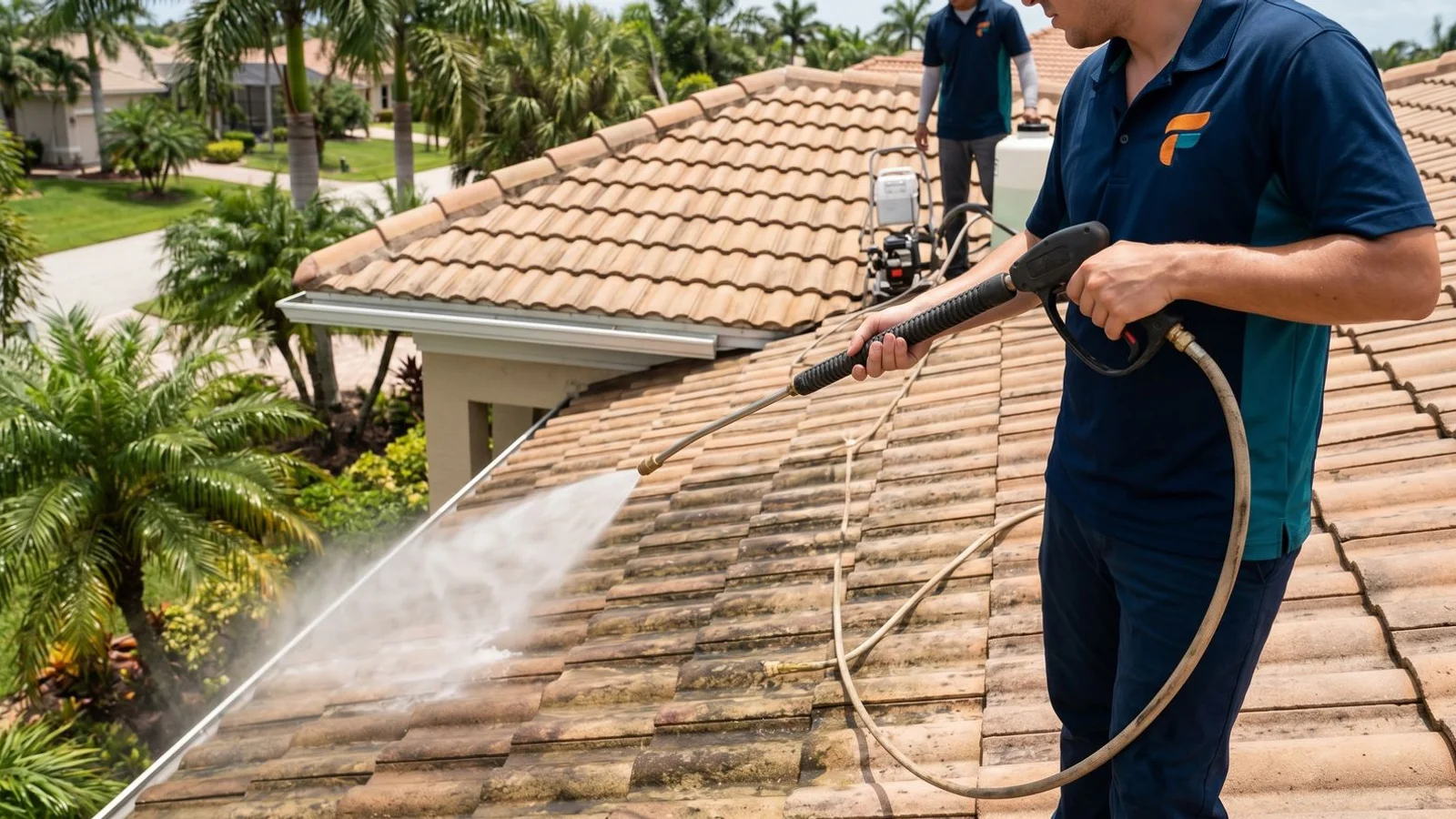
The roof cleaning industry uses two methods, and they aren’t interchangeable. Soft wash uses chemistry at low pressure to kill biological growth at the root. Pressure wash uses water force to blast staining off the surface. On a roof, only one of those is safe.
Here’s exactly what soft wash roof cleaning is, why it works, and why it’s the only method the Asphalt Roofing Manufacturers Association (ARMA) approves for shingle roofs.
The Definition
Soft wash roof cleaning uses a calibrated chemistry blend applied at low water pressure (under 500 PSI) from ground level via a telescoping wand. The chemistry — typically sodium hypochlorite, surfactants, and a biocide — penetrates the algae, mold, and biological growth on the roof surface. After 5-10 minutes of dwell time, a low-pressure rinse lifts the dead organisms and the staining they caused.
The key difference from pressure washing: soft wash kills the organism. Pressure washing only rinses the visible part away while leaving the spores alive in the base layer of the roof material. That’s why pressure-washed roofs re-stain within months while soft-washed roofs hold for 2-3 years.
Why Pressure Washing Damages Roofs
The Asphalt Roofing Manufacturers Association (ARMA) explicitly recommends against pressure washing asphalt shingles. The reason is mechanical:
- Shingle granules are bonded to the asphalt base. High pressure water (3,000-4,000 PSI) blasts the granules off, exposing the asphalt to UV degradation. This shortens roof life by 5-10 years.
- Tile cracking happens when the operator walks the roof to apply pressure. Barrel tile is hollow and tile rated for foot traffic only at specific load points — a slight misstep cracks tile.
- Water intrusion under shingles or behind tile occurs when high-pressure water finds gaps that the roof was never designed to seal against.
The ARMA recommendation, the manufacturer warranty terms, and our 20 years of field experience all align: soft wash is the right method for every roof type.
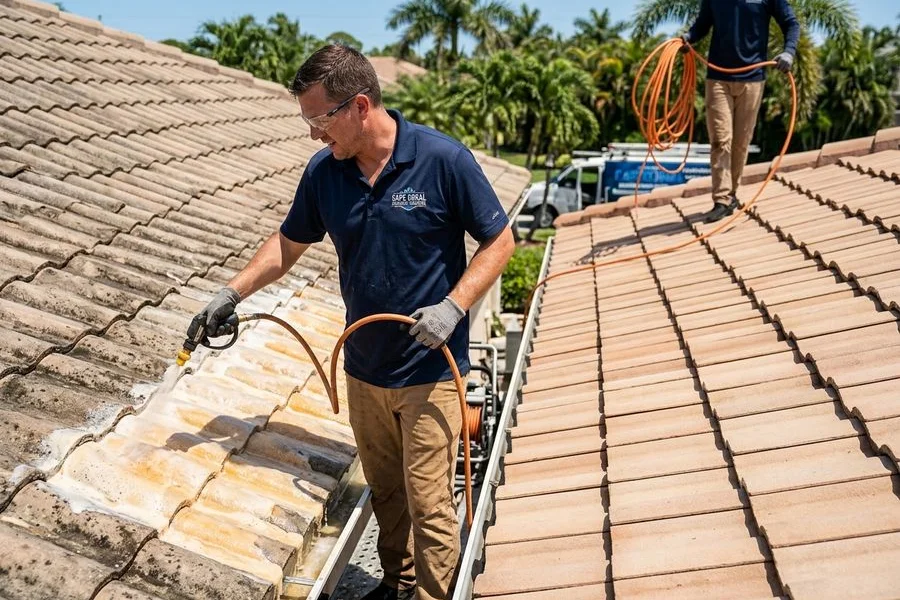
The Chemistry
The soft wash chemistry blend is calibrated for each roof material:
- Sodium hypochlorite at ARMA-aligned dilution — the active ingredient that kills Gloeocapsa magma (the black-streak cyanobacterium), mold, mildew, and lichen
- Surfactants — help the chemistry penetrate the biological growth and stick to the roof during dwell time
- Biocide — additional active ingredient for residual algae kill, prevents fast regrowth
- Neutralizer (post-rinse) — brings runoff pH back to safe range for landscaping
For metal roofs, we adjust the chemistry to be pH-balanced to protect coating and prevent corrosion. For tile, we use the same chemistry as shingle but adjust dwell time.
The Application Process
- Pre-wet landscaping — every plant in the runoff path gets soaked with clear water before chemistry comes out of the tank
- Drape sensitive plants — orchids, hibiscus, vegetable gardens, anything sensitive gets covered
- Apply chemistry — telescoping wand from ground level, working bottom-up
- Dwell — 5-15 minutes depending on staining severity and roof material
- Low-pressure rinse — top-down rinse, lifting dead organisms and chemistry residue
- Neutralizer rinse — applied to landscaping and any adjacent hardscape
The whole process for a typical SWFL single-family roof takes 2-4 hours.
What You See After
The dramatic visual transformation happens during the chemistry dwell time — the algae lifts as it dies. The rinse removes the visible streaking and the dead biological layer. The roof emerges:
- Visibly cleaner (the black streaks gone)
- Color restored to within 80-90% of original
- Granules and tile surface intact
- Algae base layer killed at the root
The remaining 10-20% of original color loss is permanent surface oxidation from years of algae growth — that’s the part chemistry can’t bring back.
What Soft Wash Cannot Do
Honest expectations matter:
- Cannot repair physical damage — cracked tiles, lifted shingles, missing flashing need a roofer, not a cleaner
- Cannot fix structural issues — soft spots, sagging, active leaks need inspection
- Cannot restore severely degraded roofs past the point where the substrate is failing
If your roof is at end-of-life regardless of cleanliness, see Roof Cleaning vs Roof Replacement for the decision framework.
Ready for a Clean Roof?
If your Cape Coral roof has visible black streaks, dark patches, or biological growth, soft wash is the right tool. See the full Soft Wash Roof Cleaning service page for method details, pricing, and FAQ — or get a free quote that includes roof type, footprint, and method.
Related Service
Soft Wash Roof Cleaning →Low-pressure soft wash treatment that lifts black algae streaks, lichen, and biological growth without damaging tile, shingle, or metal roofs.