Paver Sealing Cadence in Southwest Florida
Water-based sealers last 2-3 years in SWFL sun. Solvent-based last 4-5. Here's how to time your reseal.
You sealed your SWFL pavers a few years ago and you’re wondering whether it’s time to reseal. The answer depends on what type of sealer was applied and the visual signs the pavers are showing. Here’s the SWFL-specific cadence.
Cadence by Sealer Type
| Sealer Type | SWFL Lifespan | Northern State Lifespan |
|---|---|---|
| Water-based acrylic | 2-3 years | 3-5 years |
| Solvent-based acrylic | 3-5 years | 5-7 years |
| Color-tint (water) | 2-3 years | 3-4 years |
| Color-tint (solvent) | 3-4 years | 4-6 years |
The SWFL intervals are roughly 30-40% shorter than northern states because of UV intensity, rainfall, and humidity.
How to Tell When Reseal Is Needed
Visual cues:
- Water no longer beads — pour water on a paver. If it absorbs immediately, sealer is gone.
- Color looks faded compared to a year ago — UV is breaking through
- Weed growth in joints — joint sand washing out, sealer no longer locking it
- Surface staining that won’t wash off — porosity returning, stains penetrating
- Joint sand sparse or missing — polymeric sand reaching end-of-life
If you see 2 or more of these, schedule a reseal. Don’t wait for all 5 — the cleaning and sand refresh costs go up the more degraded the surface becomes.
What Shortens the Cadence
Within SWFL, some properties need the tight end of the range:
- Pool deck pavers — chlorinated splash + UV + foot traffic = shortest life
- Waterfront pavers — salt spray adds wear
- South-facing pavers with full sun — maximum UV exposure
- High-traffic driveways — tire wear and vehicle weight stress the sealer
- Frequent rain (lower-elevation properties) — water exposure compounds UV breakdown
These properties often need water-based reseal at 2 years and solvent-based at 3-4 years.
What Lengthens the Cadence
Some properties stretch toward the upper range:
- Shaded patios under lanai — less UV exposure
- Low-traffic walkways — minimal wear
- Pavers with color-tint sealer — pigment provides additional UV blocking
- Inland properties — no salt-spray wear
These can often stretch water-based to 3 years and solvent-based to 5 years before reseal.
The Cleaning-Only Cadence
Between full reseal cycles, annual cleaning maintains appearance:
- Year 1 (after seal): No work needed if pavers look good
- Year 2: Light annual cleaning if appearance dulled
- Year 3-5: Cleaning + sand refresh if weeds appearing
- Reseal year: Full clean-sand-seal cycle
The annual cleanings between reseals are inexpensive ($150-$400 for most SWFL driveways) and keep the surface ready for the eventual reseal.
Best Time of Year for Reseal
SWFL reseal sweet spots:
- April-June: Dry, moderate humidity, sealer cures quickly. Best window.
- October-November: Post-rainy season, dry, sealer cures well.
- December-March: Cooler temperatures slightly slow cure but still acceptable.
- July-September: Humidity and rain make cure unpredictable. Avoid when possible.
Most paver crews push July-September work into the dry season for quality reasons.
What a Reseal Visit Includes
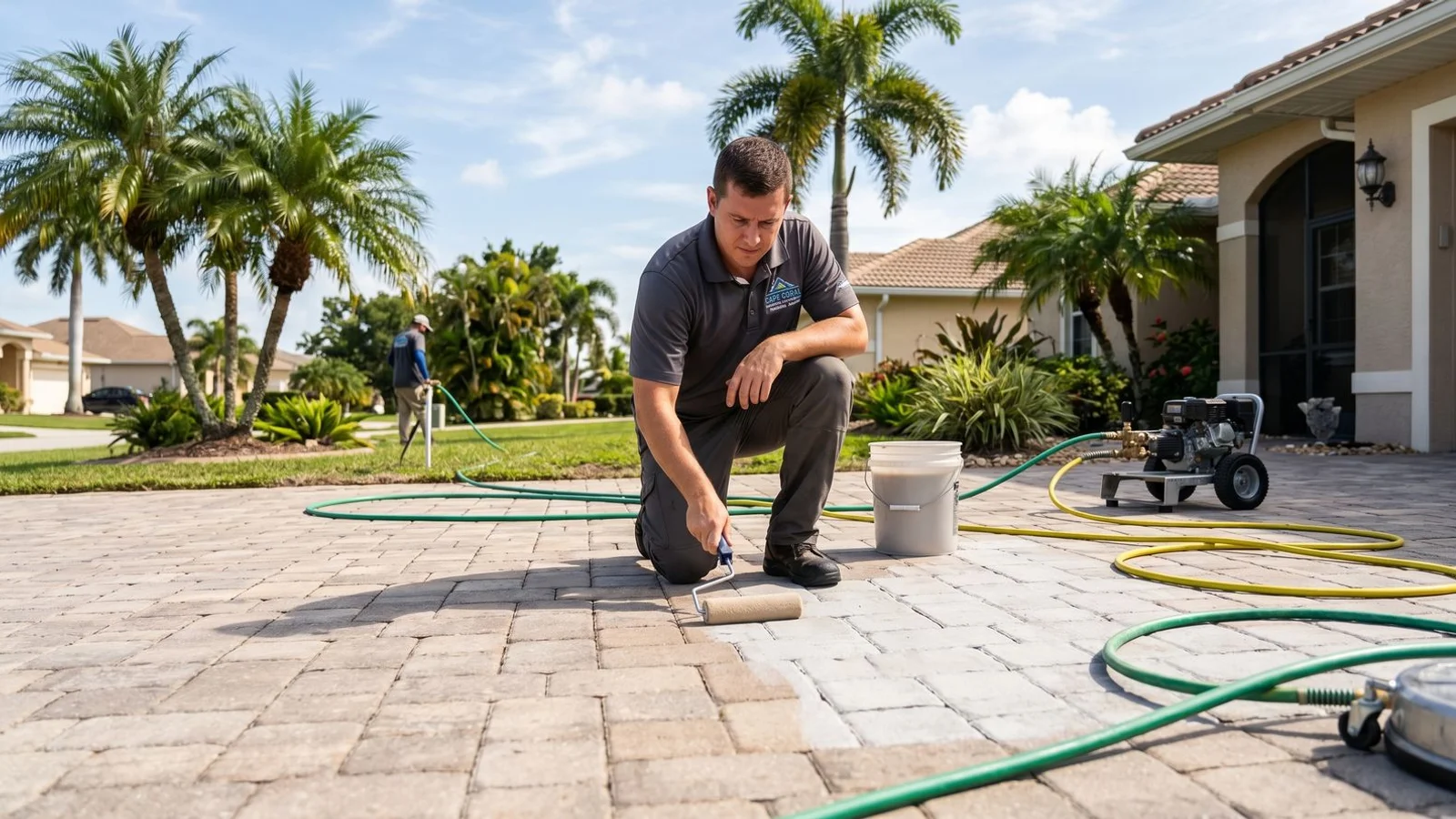
A typical reseal isn’t just sealer application — it’s a complete 3-step refresh:
- Deep clean with rotary surface cleaner — removes embedded grime
- Polymeric sand refill — fresh sand swept into joints
- Two sealer coats — applied with sprayer and roller for even coverage
Skip any step and the reseal underperforms. The clean-sand-seal cycle is the only proper approach.
Cost Math for the Long Game
For a 600 sq ft Cape Coral driveway:
- Water-based reseal every 2.5 years: $720-$1,800 per cycle, ~$300-$700/year amortized
- Solvent-based reseal every 4 years: $900-$2,000 per cycle, ~$225-$500/year amortized
Solvent-based is slightly more cost-effective long-term despite higher upfront cost. The choice often comes down to HOA restrictions, environmental preferences, and visual preference.
Get a free reseal quote — we’ll walk the surface, assess the current sealer state, and recommend a sealer type for your next cycle. See Paver Cleaning & Sealing for the full service.
Related Service
Paver Cleaning & Sealing →Multi-step clean-sand-seal process restores faded pavers, stabilizes joints with polymeric sand, and locks the finish with a UV-blocking sealer.