Why Your Pavers Have a Chalky White Film (Efflorescence)
That chalky white film is calcium hydroxide migrating to the surface. Here's how to remove it and stop recurrence.
You know how frustrating it is to finish a beautiful driveway project only to see a chalky white haze appear a few weeks later.
This powdery film on your pavers isn’t dirt, and it certainly isn’t mold. It is a natural chemical reaction called efflorescence.
Our team sees this issue constantly on Florida properties. Heavy summer rain and intense humidity accelerate the process, making efflorescence on pavers a widespread local headache.
Dealing with this white residue on pavers is entirely manageable once you understand the chemistry behind it. Let’s look at the data, what it is actually telling us, and explore a few practical ways to remove efflorescence safely.
What’s Actually Happening
Pavers are made of concrete, and concrete contains free calcium hydroxide as part of its basic chemistry. Water entering the microscopic capillaries of the material slowly carries this calcium oxide to the surface.
Our crews often explain that once this moisture hits the air, it reacts with carbon dioxide. This oxidation process creates calcium carbonate. You then see this resulting mineral as a chalky white residue.
| Phase | Chemical State | What is Happening |
|---|---|---|
| Inside the Paver | Calcium Oxide | Naturally exists in the concrete mix. |
| Moisture Contact | Calcium Hydroxide | Water dissolves the compound in capillaries. |
| Surface Exposure | Calcium Carbonate | Reacts with air to form the white haze. |
This process is scientifically known as efflorescence. It comes from the Latin word meaning to flower out. Moisture is the engine driving this entire cycle.
A 2026 study from the Interlocking Concrete Pavement Institute notes that this is a completely natural byproduct of cement hydration. You should consider this an expected phase rather than a manufacturing defect.
Our local Southwest Florida climate actually speeds this up significantly. High relative humidity and daily afternoon thunderstorms provide continuous moisture to the porous concrete. The reaction can peak in just two to four weeks here, compared to several months in dry northern states.
When You’ll See It
Efflorescence typically appears whenever environmental moisture interacts with unreacted calcium inside the stone. You will notice the heaviest mineral deposits during the first year after installation.
- New pavers (0-6 months): The concrete is still actively curing and releasing trapped moisture.
- After heavy rain: Southwest Florida averages over 50 inches of rain annually, pulling deep calcium upward.
- After irrigation overspray: Sprinkler heads routinely hitting the hardscape cause chronic, localized mineral buildup.
- After pressure washing: Saturating the stones with high-volume water triggers a fresh cycle.
- Years later: Aging sealers or changing drainage patterns allow water to penetrate older installations.
Our technicians always check sprinkler alignments before blaming the pavers. A misdirected irrigation head running three times a week is a guaranteed recipe for persistent white stains.
How to Remove It
Treating this mineral deposit requires matching your cleaning method to the severity of the stain. You can choose between natural weathering, a mild acidic wash, or specialized commercial formulas.
1. Natural Weathering
For brand new patios, the easiest fix is simple patience. Calcium continues to work its way out naturally for six to twelve months.
Regular rainfall washes the soluble salts away over time. Our clients often find the problem resolves itself completely by the second year without any chemical intervention.
2. Vinegar Solution
A homemade 50/50 mixture of white vinegar and water handles mild cases effectively. You should apply this blend with a garden sprayer and scrub the area with a stiff nylon brush.
Rinse the treated section thoroughly with clean water immediately afterward. Test this acidic solution on a small, hidden corner first. Vinegar contains acetic acid, which can lightly etch sensitive decorative finishes if left dwelling too long.
3. Commercial Efflorescence Remover
Moderate to heavy mineral crusts require targeted chemical intervention. We strongly recommend avoiding raw muriatic acid because it easily damages the concrete cream layer. Professional-grade products like Surebond Efflo Off provide a safer alternative using buffered organic salts.
These commercial treatments require a specific workflow:
- Pre-wet the surface with fresh water to cool the stone.
- Dilute the cleaner heavily (typically a 7 to 1 ratio of water to product).
- Allow a brief dwell time of 3 to 5 minutes.
- Scrub with a hard-bristle broom.
- Rinse exhaustively and apply a neutralizing agent to protect nearby landscaping.
Acidic chemical runoff easily burns delicate Florida grass varieties like St. Augustine. You must flood the surrounding soil with fresh water before and after application.
Why You Shouldn’t Just Pressure Wash It
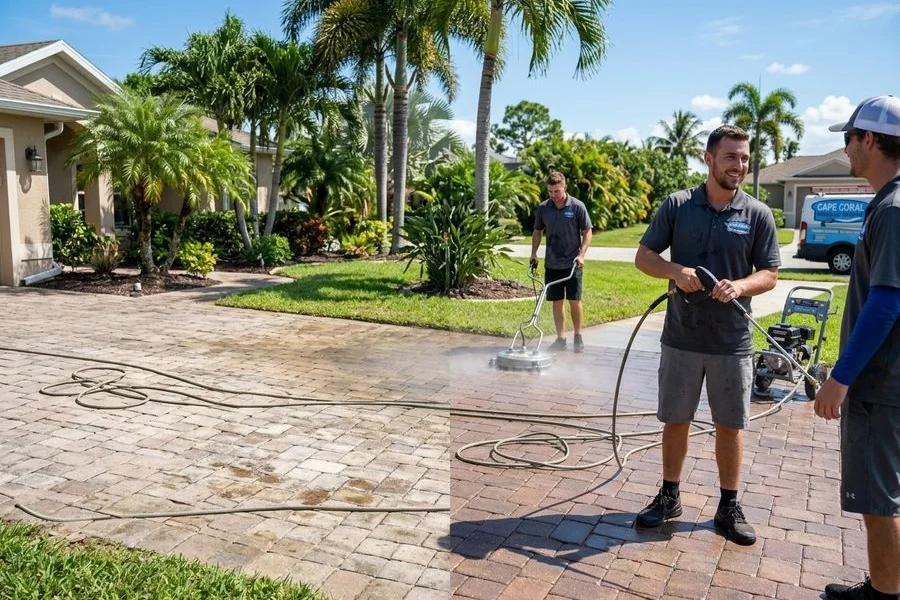
Using high-pressure water to blast away calcium deposits is a major mistake. This brute-force approach forces new water deep into the substrate and guarantees more residue will follow.
A standard commercial pressure washer easily exceeds 3,000 PSI, which is far too aggressive for decorative concrete. Our cleaning crews cap their equipment between 500 and 1,500 PSI when servicing fragile outdoor living spaces. Exceeding this limit creates two serious problems.
- It triggers a fresh chemical reaction by entirely saturating the paver core.
- It permanently etches the smooth cream finish and forcefully blows out the polymeric sand locking the joints together.
| Cleaning Method | Typical PSI | Risk to Pavers |
|---|---|---|
| Soft Wash / Chemical | Under 500 | Very Low (Safe) |
| Standard Paver Wash | 500 to 1,500 | Low to Moderate |
| Driveway Surface Cleaner | 2,500 to 4,000 | High (Damage Likely) |
Treating the issue with targeted chemistry is always faster and safer than relying on water pressure.
Preventing Recurrence
Stopping the white haze from returning requires managing how water interacts with your hardscape. You must minimize chronic moisture penetration and block water from soaking into the concrete pores.
Our installation teams follow a strict checklist to keep properties looking pristine.
- Wait for full cure before sealing: You need to wait 60 to 90 days minimum in humid environments.
- Address irrigation overspray: Sprinkler heads pointing directly at a walkway will cause endless efflorescence cycles.
- Seal pavers properly: Use a breathable silane-siloxane sealer, like Ghostshield Siloxa-Tek 8500, to create a hydrophobic barrier that still allows vapor to escape.
- Maintain drainage: Standing water puddling near the edges will wick up from the soil and drive continuous mineral migration.
If you already sealed the stones and the chalky film still comes back, the root cause is almost always an active water leak. The permanent fix involves redirecting that rogue sprinkler head, not scheduling another cleaning session.
The Sealing Question
Our technicians constantly encounter homeowners who made the mistake of sealing while efflorescence is still active. This premature application traps migrating calcium directly beneath the protective coating.
This trapped mineral deposit creates a permanent, cloudy white haze trapped inside the acrylic layer. You cannot simply wash this off with a hose. Fixing this error requires a complete chemical stripping of the entire patio to remove the ruined coating.
Pro Tip: Never apply a thick, solvent-based gloss sealer to a brand new patio. Opt for a breathable silane-siloxane penetrating formula to allow natural ground moisture to evaporate harmlessly.
Our best advice is to wait at least 60 days after a new installation, and even longer if any chalky residue remains visible. You should use a breathable, water-based penetrating sealer rather than a thick solvent-based gloss for the first application. The standard reseal cycle provides an excellent opportunity to perform a deep chemical clean before applying fresh protection.
When to Call a Pro
Most mild cases are completely manageable as a weekend DIY project using vinegar or an organic salt cleaner to remove efflorescence. You should bring in a professional contractor when the stains resist basic cleaning or span a massive square footage.
Call an expert when:
- Efflorescence covers a massive area like a multi-car driveway or a sprawling pool deck.
- Past scrubbing attempts failed to lift the heavy calcium crusts.
- You are preparing for a full reseal and need a perfectly clean, neutralized canvas.
- The stones are older and require a professional assessment of the underlying sand base.
Our dedicated paver crews handle aggressive mineral removal as a standard part of the clean-sand-seal cycle. You can read more about this exact process on our Paver Cleaning & Sealing page.
Feel free to request a quote if you want an expert evaluation. We are always ready to line-item a specialized chemical treatment to get your property back in shape.
Related Service
Paver Cleaning & Sealing →Multi-step clean-sand-seal process restores faded pavers, stabilizes joints with polymeric sand, and locks the finish with a UV-blocking sealer.