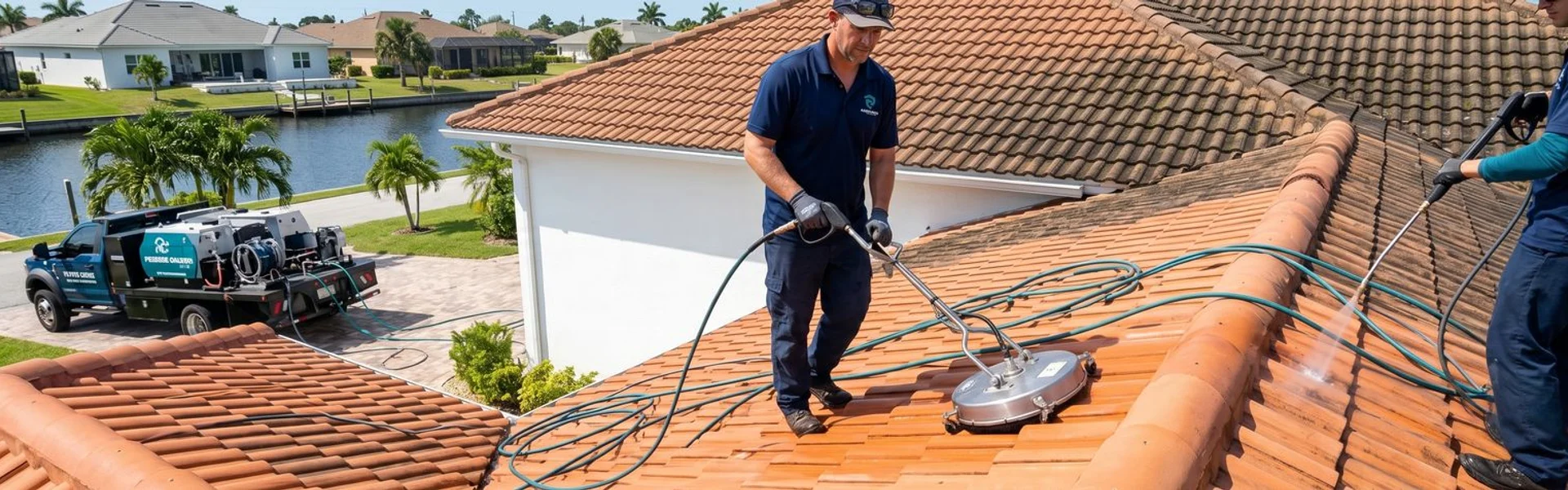
Soft Wash vs Pressure Wash on House Siding: The Real Comparison
Pressure washing siding warps vinyl, strips paint, forces water behind seams. Soft wash is the safe method.
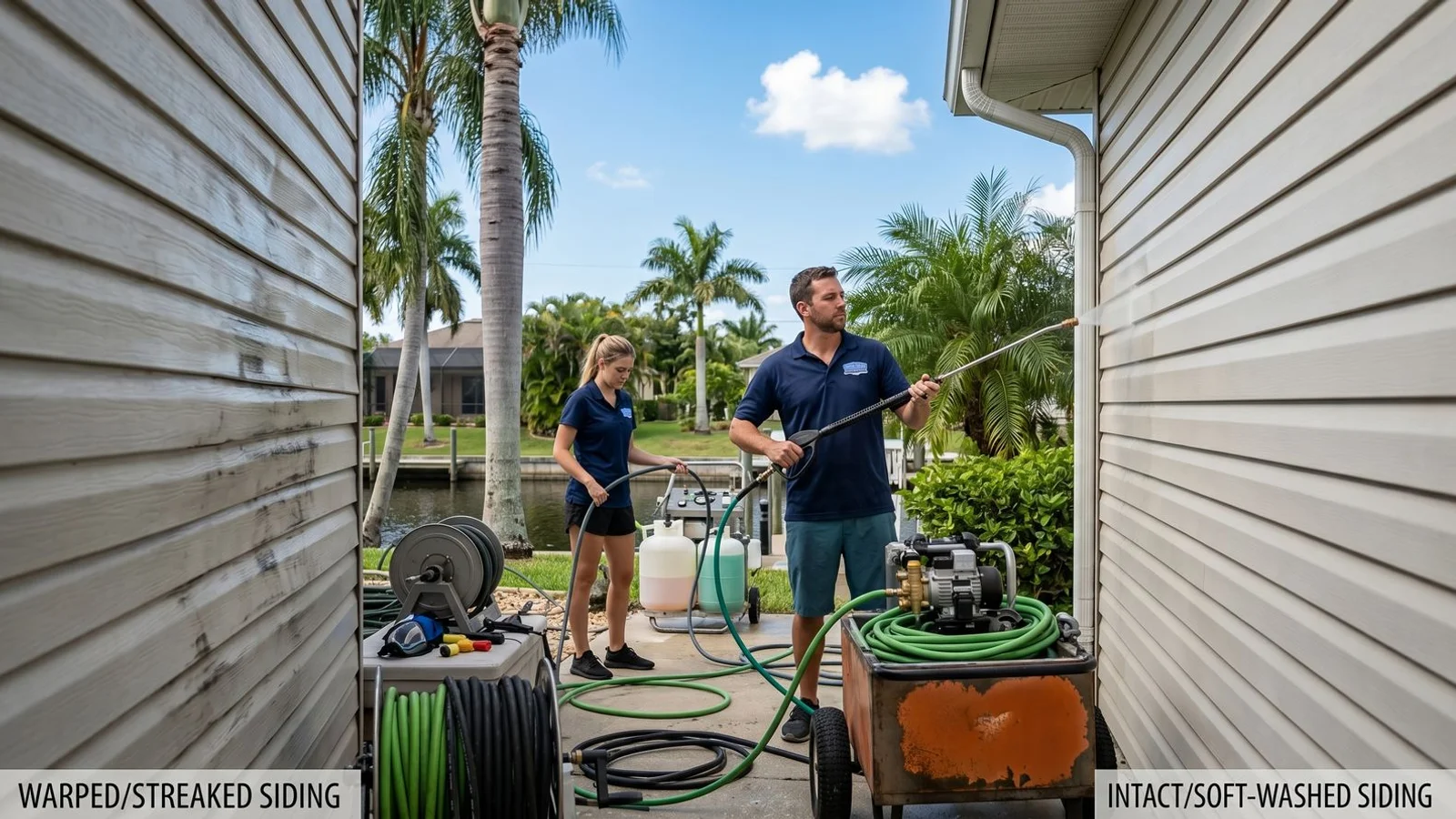
You called for house wash quotes and got two different methods: one operator recommends pressure washing, another recommends soft wash. Here’s why the difference matters and which method actually protects your home.
What Pressure Washing Does to Siding
A 3,000-4,000 PSI pressure wash is designed for concrete and hard mineral surfaces. Applied to siding, it causes specific damage patterns:
Vinyl Siding Damage
- Warped panels — heat from cleaning combined with PSI distorts vinyl
- Water intrusion — pressure drives water past overlapping seams into wall cavity
- Hidden mold — water in the wall cavity grows mold inside the walls
- Cracked older panels — UV-aged vinyl is brittle and cracks under pressure
Stucco Damage
- Surface erosion — pressure removes the textured topcoat layer
- Color loss — pigment in the topcoat washes away with the surface material
- Increased water absorption — eroded stucco absorbs water faster, accelerating future mold issues
- Visible spray patterns — striping where the wand passed too slowly
Painted Siding Damage
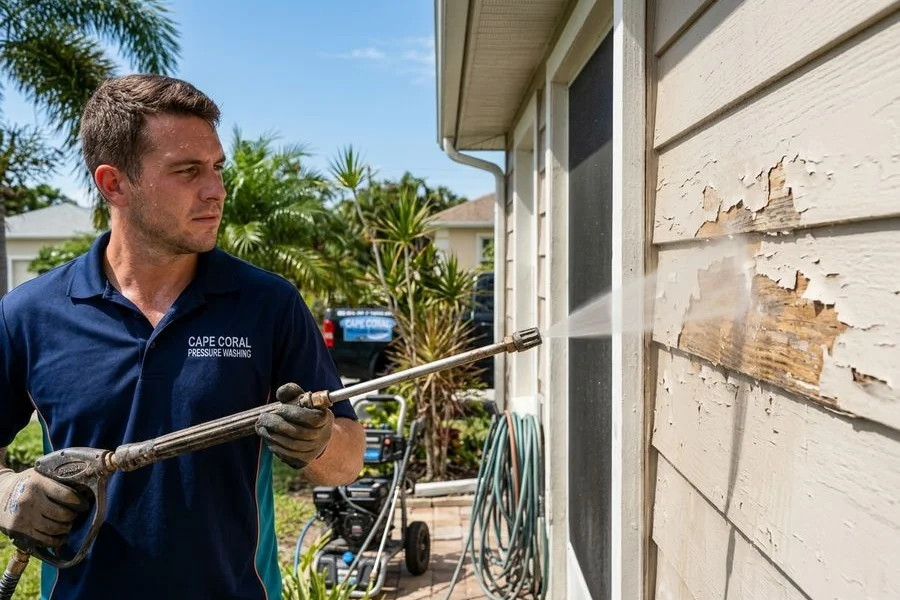
- Stripped paint — even modest pressure strips paint that was already weakening
- Forced water under siding — driven moisture leads to wood rot underneath
- Paint chalking — accelerated paint binder breakdown
Brick Damage
- Eroded mortar joints — high pressure pulled perpendicular to joints erodes mortar
- Loosened brick — over time, joint erosion lets bricks shift
- Water in walls — eroded joints don’t seal against water as designed
What Soft Wash Does Differently
Soft wash uses chemistry at low pressure (under 500 PSI). The chemistry — sodium hypochlorite with surfactants and biocide — penetrates mold and mildew at the cellular level and kills them. The low-pressure rinse lifts the dead organisms without damaging the siding.
The key advantage: chemistry kills what pressure cannot reach. Mold spores embedded in the substrate are killed by chemistry but only rinsed by pressure. That’s why soft-washed siding holds clean for 12-18 months while pressure-washed siding shows mold return within 3-6 months.
The Real Comparison
| Factor | Pressure Wash Siding | Soft Wash Siding |
|---|---|---|
| Vinyl panel safety | Warping risk | Safe |
| Paint preservation | Strips paint | Paint-safe |
| Stucco surface | Erodes | Preserved |
| Water intrusion risk | High | Minimal |
| Mold return | 3-6 months | 12-18 months |
| Manufacturer warranty | Often voids | Preserves |
| Effectiveness on heavy mold | Surface only | Kills at root |
| Speed per visit | Faster | Slightly slower |
| 5-year total cost | Higher (more visits + damage) | Lower |
Why Some Operators Still Pressure Wash
Three honest reasons:
- Equipment cost — proper soft wash systems with low-pressure pumps cost $3,000-$10,000+. A consumer pressure washer is $500. Some operators haven’t invested.
- Speed — pressure washing is faster (no chemistry dwell time). Higher throughput = more revenue per day.
- Customer education gap — many homeowners don’t know to ask, so the operator delivers what’s easier.
None of those reasons protect your siding. The first time you have to replace warped vinyl or repair paint damage, the “savings” from cheaper pressure washing turn into significant repair costs.
How to Filter Quotes
Three questions to ask:
- What PSI will you use on my siding? (Right answer: under 500 PSI)
- What chemistry will you use, and what’s the dilution rate? (Right answer: specific chemistry, paint-safe dilution)
- What’s the dwell time before rinse? (Right answer: 5-15 minutes)
An operator who hedges or improvises on these is the one whose pressure wash will damage your siding.
Soft Wash on Different Siding
Soft wash works on every common SWFL siding type — vinyl, stucco, painted wood, fiber cement (Hardie board), brick, even older metal siding. The chemistry adjusts; the method stays consistent. See Cleaning Vinyl, Stucco, and Painted Siding Safely for material-specific details.
The Long-Term Math
For a typical SWFL home over 10 years:
- Pressure wash approach: $300-$600/visit × twice yearly = $6,000-$12,000 + paint repair costs + potential vinyl replacement = $8,000-$18,000
- Soft wash approach: $300-$800/visit × every 12-18 months = $2,000-$6,000 + extended paint life = net cheaper
The soft wash approach saves money and protects the home. The only scenario where pressure wash makes financial sense is if you don’t care about the siding’s long-term condition.
Our Method
We use House Washing (soft wash) exclusively on all SWFL homes — vinyl, stucco, painted, brick, mixed materials. The chemistry is calibrated for each surface. The pressure stays under 500 PSI. The results last 12-18 months. Get a free quote and we’ll match the method to your specific siding.
Related Service
House Washing →Complete soft-wash exterior cleaning that strips mold, mildew, and grime from stucco, vinyl, brick, and painted siding without damaging paint or landscaping.