How to Clean Vinyl, Stucco, and Painted Siding Without Damage
Each siding type needs different soft wash approach. Vinyl, stucco, painted, and brick cleaning explained.
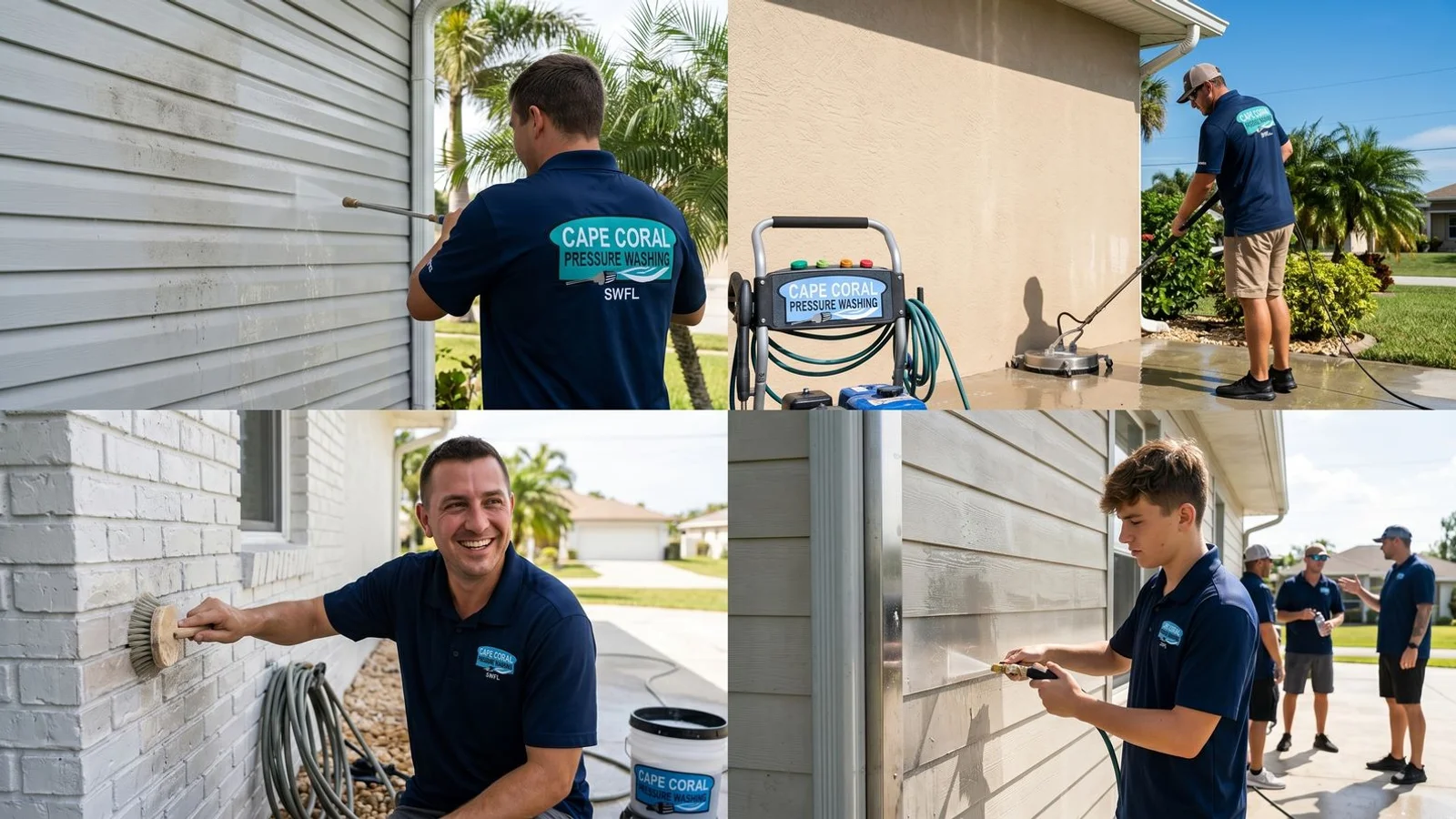
Different siding materials need different cleaning approaches. The chemistry is similar, but dilution rates and application techniques vary by substrate. Here’s how to safely clean each of the four most common SWFL siding types.
Vinyl Siding
Vinyl is the most common siding type in SWFL — affordable, weather-resistant, and lighter colors that show mold and mildew faster.
Our method:
- Soft wash chemistry at standard dilution
- Low-pressure rinse (under 500 PSI)
- Bottom-up application, top-down rinse
- Special care around overlapping panel seams
What to avoid:
- High-pressure washing (warps panels, drives water behind seams)
- Spraying upward into panel laps (forces water into wall cavity)
- Wand directly perpendicular to siding (use slight angle)
Common SWFL vinyl issues:
- Green algae on shaded sides
- Black mildew along bottom rails (irrigation overspray)
- Yellow film from pollen seasons
Vinyl responds quickly to soft wash. Most colors return to within 5% of original after a proper wash.
Stucco
Common in newer SWFL construction and luxury homes. Stucco is porous — it absorbs water more readily than vinyl, which means chemistry penetrates deeper but pressure damages faster.
Our method:
- Soft wash chemistry at adjusted dilution (slightly stronger to compensate for absorption)
- Pre-wet stucco before chemistry to prevent over-absorption
- Low-pressure rinse only (under 500 PSI)
- Special care around corners and decorative trim
What to avoid:
- High-pressure washing (erodes stucco surface, strips coating)
- Chemistry without pre-wet (stucco absorbs concentrated chemistry, can stain)
- Aggressive scrubbing (damages the textured surface)
Common SWFL stucco issues:
- Streaks down from gutter areas (organic matter wash-down)
- Mold on shaded north walls
- Salt residue on coastal homes
- Efflorescence (separate issue — calcium migration)
Stucco can be challenging — older stucco with surface degradation may show pre-existing texture more clearly after cleaning. The cleaning doesn’t cause the degradation, it just makes existing wear more visible.
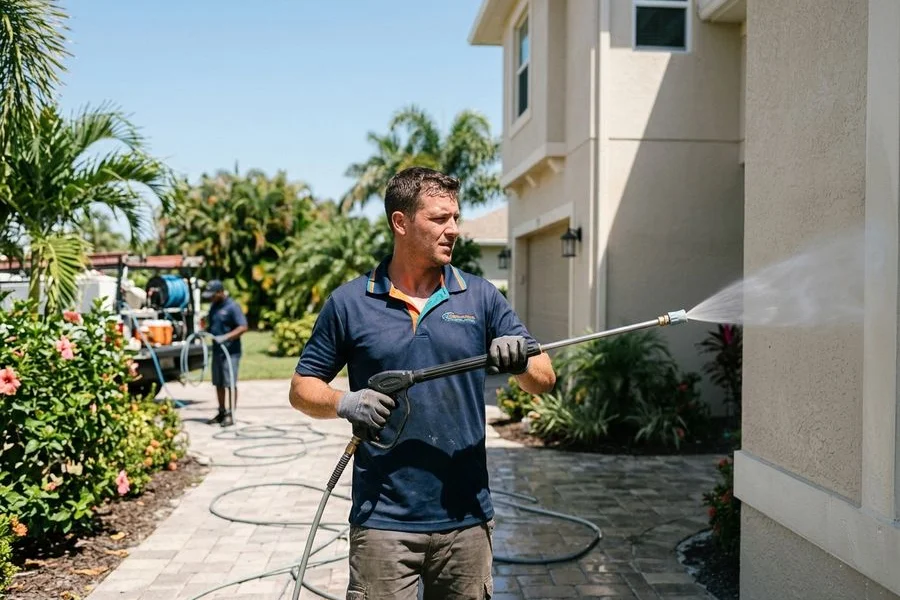
Painted Siding (Wood, Hardie Board, Etc.)
Painted wood and fiber cement siding (Hardie board) is common on coastal SWFL homes and older builds.
Our method:
- Soft wash chemistry at paint-safe dilution
- Low-pressure rinse (under 400 PSI for painted surfaces)
- Conservative approach on older paint or fresh paint (under 6 months)
- Bottom-up application
What to avoid:
- High-pressure washing (strips paint, drives water under siding)
- Strong concentration chemistry on fresh paint (paint binder not fully cured)
- Aggressive scrubbing with abrasive brushes
Common SWFL painted siding issues:
- Green mildew on north and west walls
- Chalking on south walls (UV-degraded paint)
- Salt residue on coastal homes
- Spider web accumulation around eaves
Painted siding shows the most dramatic transformation after soft wash — the difference between “looks old” and “looks freshly painted” can be just a soft wash visit.
Brick
Less common in SWFL than other regions, but present on some older builds and contemporary architecture.
Our method:
- Soft wash chemistry adjusted for brick (chemistry penetrates mortar joints)
- Low-pressure rinse direction parallel to mortar joints (not perpendicular)
- Special attention to chimney brick and decorative brick features
What to avoid:
- High-pressure rinse perpendicular to mortar joints (erodes mortar)
- Concentrated chemistry on aged mortar (can degrade mortar bond)
- Aggressive scrubbing with wire brushes (damages brick surface)
Common SWFL brick issues:
- Green algae on shaded brick
- Mortar joint mildew
- Salt residue on coastal brick
- Mineral deposits from irrigation
Material Comparison Table
| Material | Pressure Limit | Chemistry | Common Issues |
|---|---|---|---|
| Vinyl | under 500 PSI | Standard dilution | Algae, mildew, pollen |
| Stucco | under 500 PSI | Stronger dilution | Streaks, mold, efflorescence |
| Painted | under 400 PSI | Paint-safe dilution | Mildew, chalking, salt |
| Brick | under 500 PSI | Brick-adjusted | Algae, mortar mildew |
Mixed-Material Homes
Many SWFL homes have multiple siding types — stucco main walls, painted accent boards, brick chimney. We adjust chemistry and pressure for each surface during the same visit. The crew knows to recalibrate between materials.
The Common Mistake
Most siding damage we see comes from operators using “one setting for everything” — usually high-pressure, single chemistry dilution. The result: vinyl warped, stucco eroded, paint stripped, mortar damaged. All in one job.
A proper soft wash adjusts to each surface. That’s why the method takes a little longer per home but produces dramatically better results.
Get a Quote
For your specific home (whatever combination of siding materials), get a free quote — we’ll line-item the method for each surface. See House Washing for the full service.
Related Service
House Washing →Complete soft-wash exterior cleaning that strips mold, mildew, and grime from stucco, vinyl, brick, and painted siding without damaging paint or landscaping.