DIY Solar Cleaning or Professional Service: What's the Right Choice?
DIY solar cleaning risks warranty void, roof falls, and damage. Pros use deionized water and warranty-safe brushes.
Many homeowners think grabbing a garden hose is a perfectly fine way to clear dust off their rooftop array. We see this mistake happen all the time across Southwest Florida.
In reality, comparing diy vs professional solar panel cleaning reveals that everyday household tools actually degrade your system’s efficiency.
The methods that work on concrete driveways and rain gutters are exactly the wrong methods for delicate photovoltaic glass. You might be tempted to handle this chore yourself since you already clear leaves off the roof every few months.
Our team is going to break down the actual risks of common household washing methods, look at the data on local water hardness, and then show you exactly how a pro handles the job safely. Let’s look at the costs, the equipment, and the warranty rules so you can make the right decision for your home.
What DIY Solar Cleaning Usually Looks Like
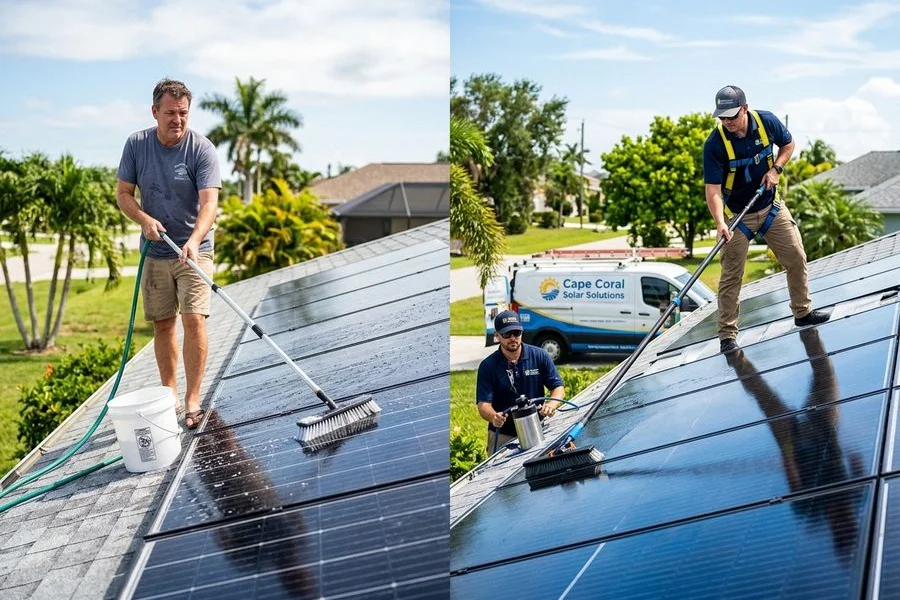
Most DIY solar cleaning usually looks like a quick Saturday chore using whatever tools are already sitting in the garage. Homeowners typically grab standard yard equipment to wash away the pollen and dirt. We constantly find evidence of these four specific DIY approaches during our field inspections.
- Hose rinse: A quick spray with a standard garden hose.
- Soapy water + sponge: A bucket of household dish soap paired with a regular car sponge.
- Pressure washer: A standard homeowner’s pressure washer set to the lowest setting.
- Window cleaning: An ammonia-based glass cleaner applied with a squeegee.
All four of these common household solutions create serious, long-term problems for your array.
What’s Wrong with Each DIY Method
What is wrong with each DIY method is that household tools create permanent microscopic damage and void manufacturer protections. Understanding the true diy solar cleaning risks helps explain why your panels require highly specific care to maintain peak production.
Hose Rinse
A basic hose rinse removes light dust, but it completely fails to lift bonded soiling like heavy pollen, dried salt residue, or baked-on bird droppings. Southwest Florida is known for having very hard water. Specifically, water testing in Cape Coral shows hardness levels of 15 to 25 grains per gallon, which is packed with calcium and magnesium.
Our technicians constantly see the aftermath of hard water drying on solar glass. The evaporation process leaves behind thick white mineral spots on the panels. These calcium deposits effectively shade the cells, reducing light transmission by 2% to 5% across the entire affected area.
Soapy Water + Sponge
Using soapy water and a sponge causes immediate friction damage to the tempered glass surface and its factory-applied anti-reflective coating. Household dish soap also leaves behind a sticky chemical film. This film acts like a magnet, attracting fresh dust and pollen much faster than bare glass.
We always warn customers about the hidden dangers of standard car sponges. A regular sponge traps tiny pieces of grit and sand against the glass. Dragging that trapped sand across the panel creates permanent scratches that permanently scatter incoming sunlight.
Pressure Washer
The primary issue with a pressure washer is that water forced past the delicate frame seals will destroy the internal electronics. The tempered glass surface might tolerate some pressure, but the silicone seals around the edges certainly cannot. Even the lowest setting on a consumer pressure washer typically hits 1,500 PSI, which far exceeds what panel seals are rated to handle.
Our repair crews often have to replace modules ruined by high-pressure spray. Water intrusion into the cell layer causes major electrical failures.
- Cell delamination and moisture trapped under the glass
- Hot spot formation that burns out specific solar cells
- Drastically reduced total system power output
- Complete voiding of the manufacturer’s equipment warranty
Ammonia-Based Glass Cleaner
Ammonia aggressively degrades the anti-reflective coating on most modern photovoltaic panels. Many top-tier panels have specific chemical sensitivities documented right in their warranty terms. Using ammonia-based window cleaners will immediately void many of these manufacturer warranties.
We strongly advise reading the specific chemical warnings from your panel brand. Windex and similar products contain solvents designed for indoor bathroom mirrors, not outdoor solar technology. The resulting chemical damage is completely irreversible.
What Professional Cleaning Uses
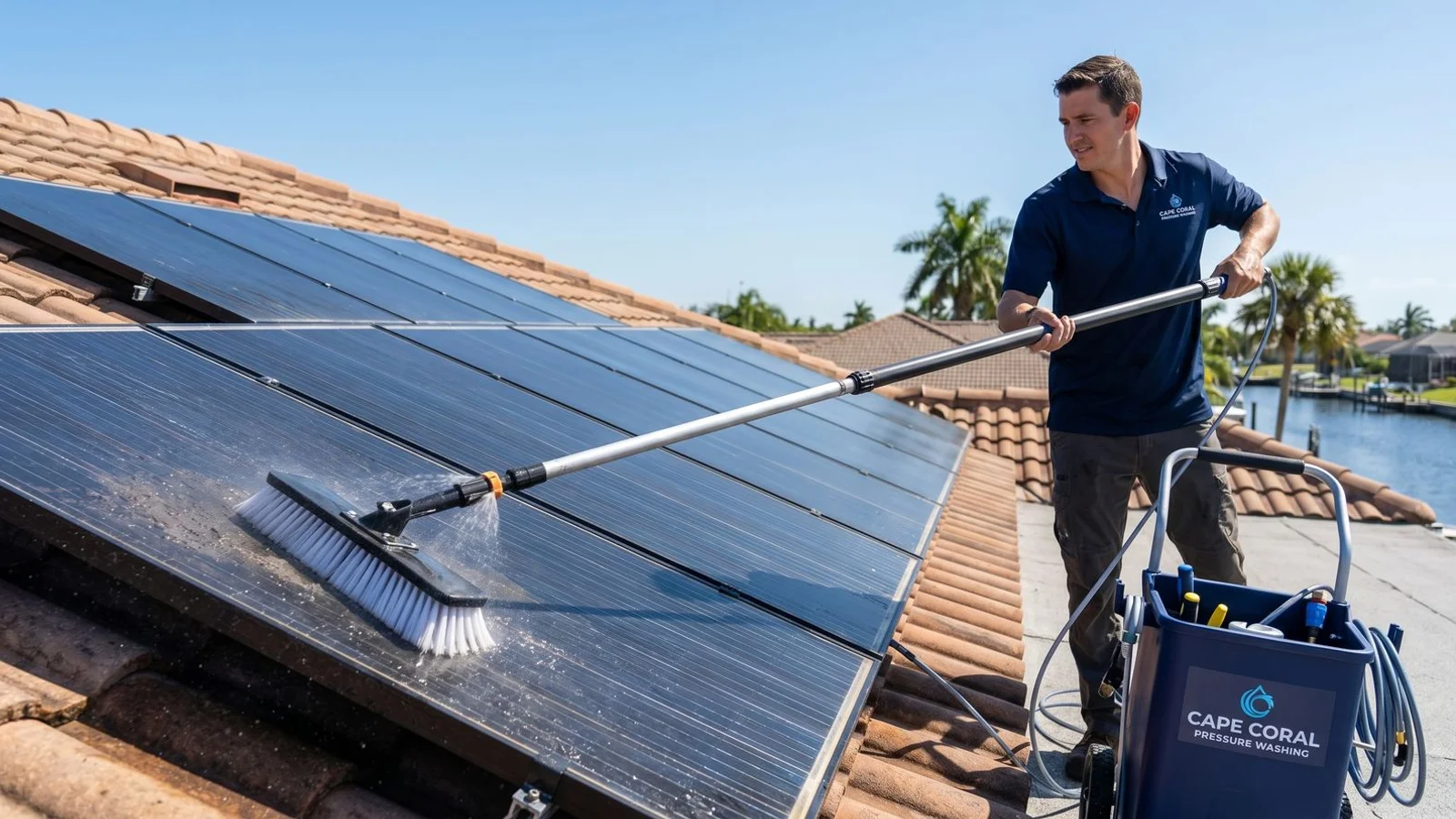
Professional solar cleaning uses purified deionized water and non-abrasive tools to safely restore maximum power output. The correct method relies on specialized gear built exclusively for solar maintenance. We utilize this specific equipment setup to guarantee a safe, warranty-compliant wash.
- Non-abrasive soft-bristle brush: A specialized boar’s hair or soft nylon brush designed for solar glass that never scratches the coating.
- Deionized water system: Highly filtered water processed down to zero parts per million, ensuring no mineral spots remain when it dries.
- Carbon fiber telescoping wand: A lightweight pole reaching up to 40 feet from ground level, eliminating the need for any roof access.
- No pressure: A gentle brushing action paired with a low-flow water rinse.
This precise combination preserves your warranty perfectly. The soft brush lifts bonded grime safely, while the pure water ensures zero calcium residue gets left behind.
Why Roof Access Matters
Roof access matters because working on a sloped, elevated surface introduces severe, life-threatening fall risks for untrained homeowners. Solar panels are typically installed on the highest, steepest slopes of a property to capture maximum sun exposure.
Our safety protocols strictly forbid unnecessary roof climbing for a good reason. According to 2024 data from the Bureau of Labor Statistics, falls to a lower level accounted for 389 fatal injuries in the construction industry.
A single slip on a wet, soapy roof can result in:
- Severe physical trauma from a multi-story fall
- Thousands of dollars in personal medical bills
- Significant damage to your home’s roof tiles or gutters
Professional cleaning companies bypass this danger completely. An expert crew uses long telescoping equipment to agitate and rinse the panels directly from the ground. Keeping the homeowner off the roof entirely eliminates the risk of a devastating fall.
Cost Comparison
A true cost comparison shows that professional service is actually cheaper than a DIY approach for your first cleaning when you factor in the required specialty gear. Let’s look at the real numbers for proper maintenance in 2026.
DIY Equipment
Buying the right gear to safely wash your system requires a surprisingly high initial investment. You cannot use standard hardware store buckets and mops.
- Solar-safe soft-bristle brush head: $40 to $80
- Carbon fiber telescoping pole (15 to 30 ft): $80 to $200
- Deionized water (5 gallons): $30 to $60, or buy a small DI resin tank for $150 to $300
- Total first-time DIY cost: $150 to $400
Subsequent cleanings require less money, but they still cost you replacement materials.
- Replacement DI water filter cartridge: $30 to $60
- Total per-cleaning DIY cost: $30 to $60 (plus your personal time and severe physical risk)
Professional Cleaning
Hiring an expert shifts the equipment burden and the physical risk away from you entirely. Our pricing reflects the local Southwest Florida market rates for 2026.
- Per-visit cost: $200 to $500 (based on a standard residential array in Cape Coral)
- Twice yearly maintenance: $400 to $1,000 annually
- Zero personal equipment purchases required
- Zero roof access or physical fall risk
- Equipment warranties remain fully preserved
- Power production restoration gets professionally documented
The Math
The math proves that diy vs professional solar panel cleaning is essentially a break-even financial proposition on day one. For most Cape Coral homeowners, the choice comes down to personal safety versus a small long-term saving.
We always break the initial numbers down like this for our local clients.
| Factor | First-Time DIY Attempt | First Professional Cleaning |
|---|---|---|
| Initial Cost | $150 to $400 (equipment purchases) | $300 to $500 (average SWFL service) |
| Physical Risk | High (requires climbing onto a pitched roof) | None (handled safely from the ground) |
| Warranty Status | High risk of voiding due to improper tools | Fully preserved and documented |
Pro pricing easily wins on the very first cleaning when proper equipment purchases are factored in. After that initial investment, the DIY route becomes cheaper per wash. The steep physical risk and strenuous effort never go away.
DIY can make sense if you already own an expensive DI water tank and feel entirely comfortable walking on a hot, pitched roof. Professional service is the smartest, safest call for the vast majority of local residents.
Warranty Considerations
Warranty considerations are critical because cleaning your panels with the wrong tools will instantly void your production guarantees. Most top-tier solar panel manufacturers have highly specific cleaning protocols written directly into their warranty documents. Brands like Enphase, SolarEdge, REC, LG, Panasonic, and Tesla all mandate the same basic care rules.
We read these warranty documents daily to ensure our methods remain perfectly compliant. The most common manufacturer requirements strictly forbid the following actions.
- No pressure washing or high-pressure spray of any kind
- No abrasive materials, stiff brushes, or standard sponges
- No ammonia-based chemical cleaners or harsh solvents
- Deionized or purified water rinses are heavily preferred to prevent calcium buildup
A professional cleaning team follows these exact manufacturer requirements on every single job. The DIY approach frequently results in a voided warranty because most busy homeowners simply do not read the fine print in their equipment contracts.
When DIY Does Make Sense
DIY cleaning makes sense only if you have a small, easily accessible system and you are willing to invest in commercial-grade water filtration. You also need to be fully prepared to handle the physical labor. Our crew recommends the DIY route only if you can confidently check all of these specific boxes.
- You already own a soft-bristle solar brush and a deionized water tank.
- You are entirely comfortable and properly harnessed for safe roof access.
- You own a small ground-mounted array that requires zero ladder work.
- You can easily source replacement deionized water resin locally.
- You are fully committed to following your specific manufacturer’s cleaning specifications.
The mathematical realities and physical risks strongly favor professional cleaning for most rooftop residential installations in Cape Coral.
Get a Pro Quote
Getting a professional quote ensures you know exactly what a safe, warranty-compliant cleaning will cost for your specific property. You can easily protect your expensive renewable energy investment without ever climbing a ladder.
For warranty-safe, properly-documented solar panel cleaning, request a free quote. See Solar Panel Cleaning for the full method. We make the scheduling process fast and stress-free for Southwest Florida property owners. Let’s get your array producing maximum power again.
Related Service
Solar Panel Cleaning →Non-abrasive soft-bristle cleaning with deionized water rinse, restoring solar panel output without scratching tempered glass or voiding warranties.