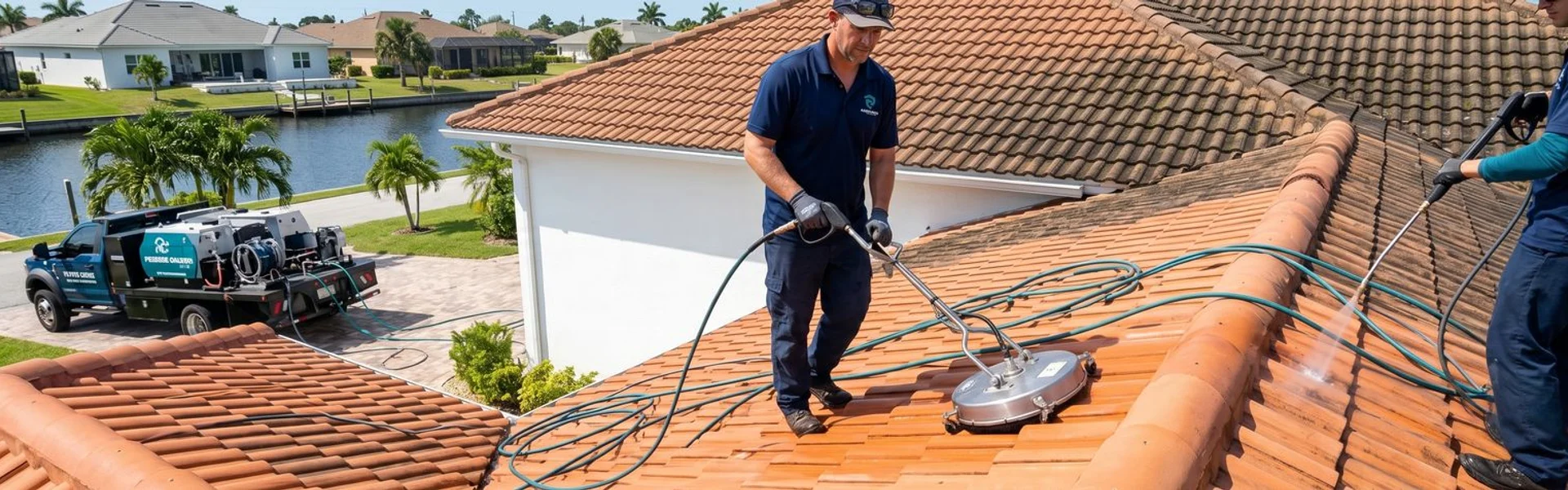
Why Pressure Washing Can't Touch Rust Stains (and What Can)
Rust is a chemical bond — water force can't break it and often etches concrete. Why chemical extraction is the only fix.
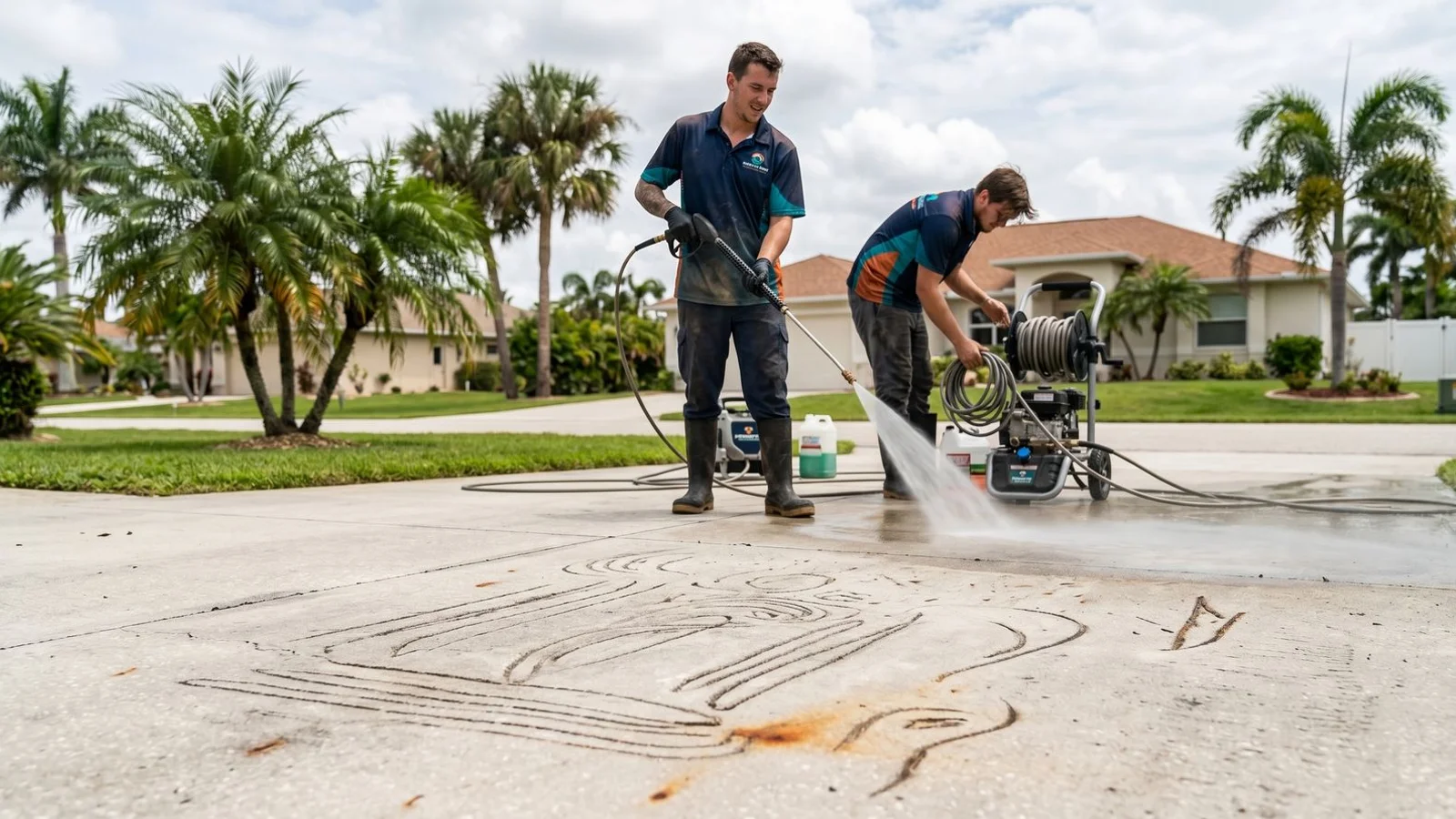
You tried pressure washing the orange stains on your driveway. They didn’t come out. You tried again with more pressure. The concrete is now rougher than before and the stains are still there. The problem isn’t your effort — it’s that pressure washing is the wrong tool entirely for rust. Here’s why.
What Rust Actually Is
Rust on concrete is iron oxide — the same chemical compound that forms on a piece of metal left outside. When iron-containing water (irrigation, fertilizer runoff, metal furniture bleed) contacts concrete, the iron ions migrate into the porous concrete matrix and oxidize.
The key word: chemical bond. The iron isn’t just sitting on the surface like dirt. It has bonded chemically with the calcium compounds in the concrete. Breaking that bond requires reversing the chemical reaction — not water force.
What Water Pressure Does (and Doesn’t Do)
A pressure washer at 3,000-4,000 PSI applies mechanical force to a surface. It works great for:
- Loose dirt and surface contamination
- Oil and grease (with pre-treatment)
- Biological growth (mold, mildew, algae)
- Tire marks and brake dust
What it doesn’t work for: chemical bonds. No amount of mechanical force breaks the iron-calcium bond holding rust in place.
What pressure washing does to rust-stained concrete:
- Etches the surrounding concrete — pressure wears down the surface around the stain
- Exposes more porosity — etched concrete has more surface area for iron to embed into
- Embeds iron deeper — water-driven iron particles push further into newly-exposed porosity
- Makes the problem visually worse — stain remains, surface is now damaged
We see this exact pattern weekly on SWFL driveways: rust stains still there, surrounding concrete etched to a rougher texture, and the homeowner frustrated that “more cleaning” made it worse.
What Actually Works: Acidic Chemistry
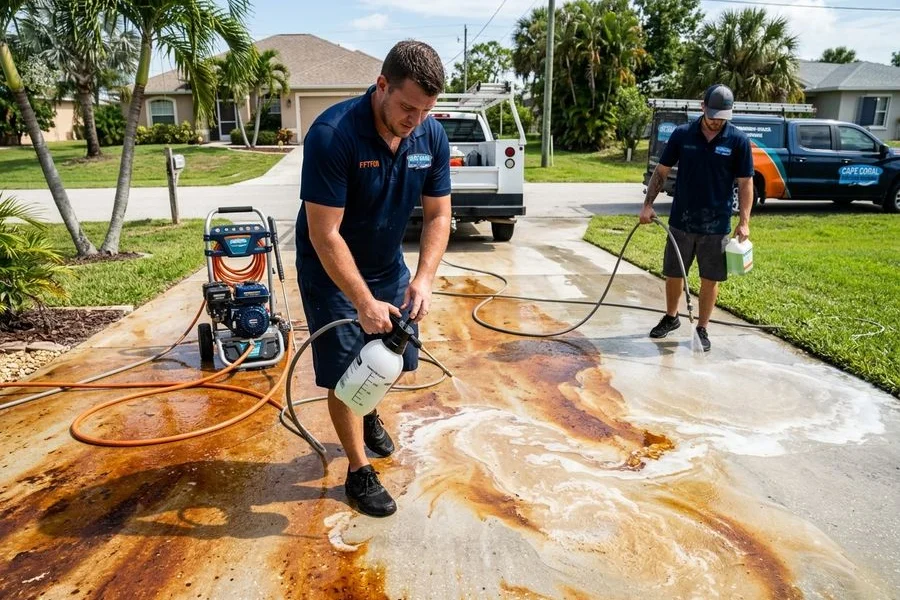
Rust extraction requires chemistry that reverses the iron oxidation. The two main options:
Oxalic Acid
- Milder, slower-acting
- Best for fresh and moderate stains
- Lower environmental impact
- Easier to neutralize
- Available in DIY-grade and professional concentrations
F9 BARC (Front 9 Restoration’s BARC)
- Commercial-grade rust remover
- Faster, more aggressive
- For older, deeply-bonded stains
- Requires more careful handling and containment
We test a patch first to determine which chemistry is right for your specific stain age and surface type.
The Chemical Reaction
When acidic chemistry meets rust on concrete:
- Acid penetrates the concrete pores where iron is bonded
- Acid reacts with iron oxide, converting it to a soluble iron compound
- The reaction is visible as the orange brightens momentarily then begins to lift
- The soluble iron is rinsed away from the concrete
- Neutralizer applied to return surface to safe pH
The reaction works because it specifically targets the iron bond — not the concrete. Done correctly, the concrete substrate is unchanged after the rust is removed.
EPA-Compliant Handling
Acidic chemistry needs proper handling:
- Containment berm around the work area
- Pool filtration covered if nearby
- Pre-wet adjacent plants
- Neutralizer applied immediately after dwell
- Full rinse with fresh water
- pH check before leaving
Done correctly, the area is safe for plants and pets after the neutralizer rinse. Done incorrectly (DIY without containment), acidic runoff can harm landscaping and pool chemistry.
Why Pros, Not DIY
DIY acidic rust removal has three problems:
- Chemistry selection — using oxalic when F9 is needed (or vice versa) wastes time and money
- Concentration / dilution — proper application requires calibrated concentration
- Containment / neutralization — runoff into pool, plants, or waterways causes secondary damage
Pro rust removal is one of the higher-value services in our lineup because the difference between success and disaster is so significant.
Common DIY Failures
Things we see homeowners try that don’t work:
- Bleach — for organic stains, not iron
- Vinegar — too weak to break the iron bond
- CLR or rust removers from hardware store — sometimes work on light stains, often inadequate for moderate-heavy iron
- Wire brush scrubbing — abrades concrete, doesn’t lift rust
- Pressure washing harder / more passes — makes the problem worse
The Right Approach
For rust stains on your SWFL driveway, stucco, or pool deck:
- Don’t pressure wash again
- Identify the stain source (irrigation? fertilizer? metal?)
- Get a professional rust removal quote
- Address the source (sprinkler redirection, fertilizer technique) to prevent recurrence
See Preventing Irrigation Rust for the prevention angle.
Get a Quote
For chemical rust extraction in Cape Coral and SWFL, request a free quote. See Rust Stain Removal for the full service.
Related Service
Rust Stain Removal →Chemical rust extraction using EPA-compliant acidic solutions (oxalic acid, F9 BARC) for irrigation and fertilizer rust stains pressure washing alone cannot remove.