EPA Clean Water Act and Commercial Pressure Washing
Commercial pressure washing must comply with EPA Clean Water Act — reclamation, drain blocking, biodegradable detergents.
We understand that maintaining commercial properties in Southwest Florida comes with heavy regulatory scrutiny. Many property managers face a hidden liability when hiring maintenance vendors for routine exterior cleaning. Ignoring the Clean Water Act requirements often leads to steep fines.
Our team routinely sees the fallout when unverified contractors skip proper wash water containment. You can protect your property by understanding exactly how compliant pressure washing works. Let us look at the specific requirements, the actual costs, and how to protect your investment.
What the Clean Water Act Requires
We always emphasize that the federal Clean Water Act regulates any pollutant discharge into “waters of the United States.” This specific rule means wash water containing detergent, dirt, or oil cannot enter storm drains untreated. Our local waterways face intense pressure from unchecked runoff.
For Southwest Florida specifically, local stormwater regulations layer extra rules on top of federal mandates.
- Storm drains in Cape Coral, Fort Myers, and Naples lead directly to canals and the Gulf of Mexico.
- Waterfront commercial properties sit within direct discharge distance of the Caloosahatchee River and Estero Bay.
- The Florida Department of Environmental Protection classifies any non-stormwater discharge as an illicit act.
We design every cleaning plan around these strict geographic realities. A single incident of wash water reaching a Caloosahatchee basin drain can trigger immediate enforcement actions.
What Compliance Actually Looks Like
We treat commercial cleaning near storm drains as a highly technical operation. For any job where runoff might reach the street, strict procedures apply.
Our compliance strategy focuses on completely isolating the work area.
Wash-Water Reclamation
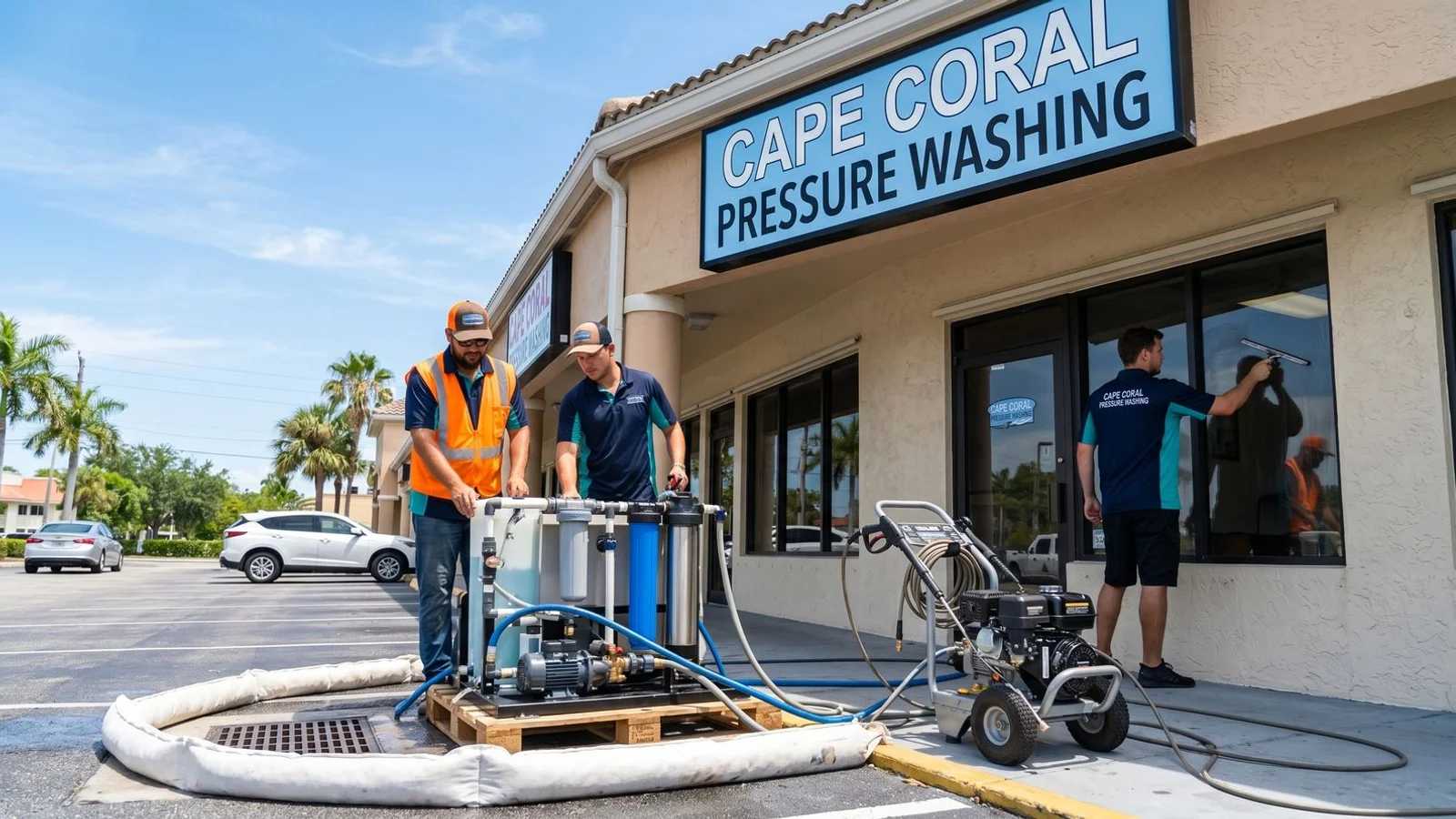
We utilize active capture systems to collect all runoff during the cleaning process. Specialized equipment prevents contaminated water from migrating off the property.
Our typical setup involves one of two proven approaches:
- Vacuum reclamation: A heavy-duty wet vacuum system recovers up to 10 gallons per minute directly at the surface cleaner head.
- Berm and pump: Polyurethane containment berms block the area, and pumps push the water to a 200-gallon holding tank.
We then transport the captured wash water to an approved local wastewater treatment facility. Official disposal manifests prove the volume and destination of the fluid.
Drain Blocking
We deploy physical barriers for work near specific storm drains. A simple fabric mat is completely inadequate for commercial jobs.
Our technicians seal the drain opening tightly using heavy-duty polyurethane drain covers or weighted gravel bags. The runoff then pools in a designated low spot for the vacuum reclamation system to collect.
Biodegradable Detergents
We strictly use biodegradable, EPA-registered detergents for all exterior maintenance. Using harsh, unregistered chemicals creates unnecessary environmental hazards.
Our preferred solutions, like Vital Oxide or Hotsy biodegradable lines, offer several distinct advantages.
- Reduces the environmental impact of any incidental surface runoff.
- Lowers bulk disposal costs at the municipal treatment plant.
- Provides proof of a “good faith effort” during environmental audits.
Documentation
We provide a comprehensive paper trail to protect property managers from regulatory scrutiny. Proper records serve as your primary defense during an inspection.
Our final compliance package includes several crucial details:
- Total volume of wash water collected and transported.
- Official disposal destination manifest.
- Specific detergents used, including EPA registration numbers.
- Date, location, and site conditions during the work.
We know this specific documentation protects the property owner from shared liability.
When Compliance Is Required
We apply strict Clean Water Act protocols to specific high-risk property types. Routine residential driveways rarely see federal enforcement, but commercial spaces carry different expectations.
Our teams mandate full compliance setups for the following locations:
- Commercial properties with direct storm drain access in the cleaning zone.
- Dumpster pads and high-traffic gas station parking lots.
- Properties adjacent to canals, rivers, or bays.
- Locations within designated environmentally sensitive areas.
We recommend containment protocols even for smaller jobs. A proactive approach prevents accidental discharge and builds long-term property value.
The Risks of Non-Compliance
We caution property managers against taking shortcuts with exterior cleaning. The financial and legal risks heavily outweigh the short-term savings of hiring an uncertified vendor.
Our experience highlights three specific danger zones for property owners.
1. Regulatory Fines
We track federal penalty adjustments closely to advise clients accurately. Ignorance of the law provides zero defense against these staggering numbers.
Our recent data shows the EPA raised the maximum civil penalty for Clean Water Act violations to $68,445 per day for 2025 and 2026. Local agencies like Lee County Environmental Management can also levy fines up to $10,000 per incident.
2. Property Owner Liability
We frequently remind managers that liability flows upward. The property owner often shares the blame if a hired contractor dumps pollutants illegally.
Our detailed service records prove you hired a compliant operator. This paperwork acts as an essential shield against shared liability claims.
3. Insurance and Permit Issues
We review many commercial property insurance policies that feature strict pollution exclusions. An environmental violation can void your coverage entirely.
Our compliant methods satisfy the strict terms found in modern HOA agreements, lease contracts, and municipal permits.
What to Ask Your Commercial Operator
We encourage clients to aggressively interview potential cleaning contractors. A few specific questions will instantly reveal an operator’s true capabilities.
Our recommended vetting checklist includes these non-negotiable questions:
- Do you use a vacuum recovery surface cleaner for wash-water reclamation?
- Will you provide an official wastewater disposal manifest with the final invoice?
- Can I have a current copy of your Certificate of Insurance (COI) covering pollution liability?
- Are your detergents EPA-registered, and can you provide the product data sheets?
We guarantee a trained professional will answer all four questions confidently. An operator who hesitates creates a massive compliance exposure for your property.
Our Compliance Approach
We integrate environmental protection into every service package. For Commercial Pressure Washing work, our standard operating procedure ensures total peace of mind.
Our comprehensive service includes several mandatory steps:
- Active wash-water reclamation on every single job that requires it.
- Complete documentation packages, including disposal records and COI.
- Direct coordination with property management for specific reporting needs.
- Off-hours scheduling options to minimize tenant and customer disruption.
We handle the regulatory burden so you can focus on managing your facility.
Compliance Doesn’t Cost as Much as You’d Think
We constantly battle the misconception that proper environmental controls destroy maintenance budgets. A quick analysis of the numbers proves otherwise.
Our transparent pricing model shows that full compliance only adds 10% to 15% to a standard commercial cleaning invoice. The potential penalties cost exponentially more.
| Financial Factor | Non-Compliant Operator | Compliant Operator |
|---|---|---|
| Standard Job Cost | $2,000 | $2,300 |
| Wash Water Reclamation | None (Illegal Dumping) | Included (Vacuum Recovery) |
| EPA Liability Risk | Up to $68,445 per day | $0 (Fully Documented) |
| Total Potential Exposure | Over $70,000 | $2,300 Fixed Cost |
We find that the math clearly favors doing the job right the first time. The cheap savings from an unverified vendor quickly evaporate during an environmental audit.
Get a Compliant Commercial Quote
We build custom service plans designed for your specific site requirements. Request a commercial quote and our team will line-item the exact compliance protocol for your property.
Our full Commercial Pressure Washing service menu details every step of the process.
Related Service
Commercial Pressure Washing →Heavy-duty pressure washing for storefronts, shopping plazas, corporate buildings, and multi-unit communities, scheduled around business hours.